

Growing food and connection in Massey
The community food forest at Triangle Park in Massey is set to double in size, expanding into the surrounding park to grow more food, provide shade and strengthen community connections.
The expansion began with a karakia whakawaatea led by mana whenua representative Pita Turei, of Te Kawerau ā Maki, clearing the way for the new planting and acknowledging the significance of the whenua.
Before dawn on Wednesday, 20 May, around 60 people gathered beneath the stars to honour the land, those who have come before us, and set shared intentions for the future of the space.
Pita Turei, of Te Kawerau ā Maki, describes the garden as a bridge between past and future.
“Having a garden like this that an entire community is involved in takes us deeper into the understandings of our past and gives us a grasp on the resilience of our future.”
The food forest will be managed by the Triangle Park Community Teaching Garden Charitable Trust, which has been growing food for the local community on the site for the past 12 years.
Triangle Park Community Teaching Garden coordinator, Janelle Blackmore, says the food forest has been a long‑held dream to grow more kai and connection for locals.
“For many moons now, we have been thinking and dreaming about having a food forest. The purpose of this is to grow more food for our community, feed more people, and strengthen community connections.”
Triangle Park is one of three locations taking part in an Auckland Council pilot supporting community food forests on public land. The initiative aims to strengthen local food resilience while also increasing tree cover and shade in response to a warming climate.
The community group is being mentored by local food forest practitioner Dan Kelly, who is supporting the design, establishment, and ongoing management of the food forest.
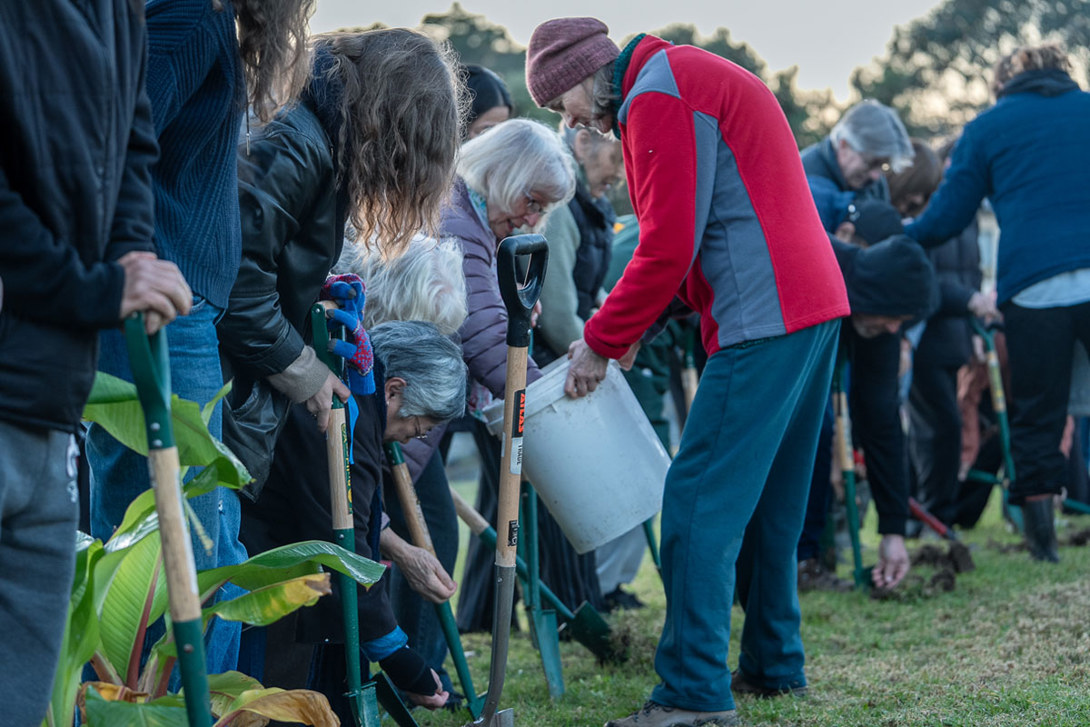 The first seeds and compost are placed in the whenua to mark the beginning of a new food forest.
It all starts with healthy soil
To give the new plantings the best start, the soil was tested to understand its nutrient levels, water holding capacity and carbon storage. This provides us a baseline to track how the food forest improves carbon storage and resilience to drought and heavy rainfall over time.
Unlike a conventional orchard, the food forest will rely on natural systems to build healthy soil. Alongside the fruit trees, fast-growing support species have been planted to enrich the soil. These plants are periodically cut back and laid around the trees as mulch in a process known as “chop and drop”.
By returning organic matter directly to the soil, this technique helps retain moisture, build fertility, and support healthy tree growth without relying on synthetic fertilisers.
As the food forest matures, it will provide an abundance of fresh kai, habitat for wildlife, cooling shade, and opportunities for the community to learn, connect, and care for the whenua together.
Want to get involved?
Follow the Triangle Park Community Teaching Garden for updates, volunteer opportunities and community events.
Learn more about Auckland Council's community food forest pilot.


You May Also Like

Manurewa’s next generation of kai growers

More Aucklanders learn to ride with local board support

Rangatahi take the stage

Signs of spring

Opening new doors
