


Manaakitanga through climate change
Across our city, the vast majority of us want caring for each other (and being cared for) to come first in everything we do, including planning for climate disruption. We mostly share a desire to live healthy, happy and long lives – and wish this for our families and communities as well.
Added pressure on communities
Climate change is a public health challenge that can increase inequality and create new physical and mental health impacts. It can affect many aspects of our wellbeing, adding pressure on communities and taking a toll on our peace of mind.
Rethinking our relationships with te taiao
The solution lies in bold adaptation and mitigation: redesigning our city and our relationship with the environment to increase wellbeing while reducing emissions. In Auckland, this means creating cooler, greener neighbourhoods, protecting people from flooding and building low-carbon ways to move, live and work. We can also learn more about changing health impacts so we can better care for ourselves and each other.
A caring future city
We can act now to create a resilient city and landscape so that the city and the whenua can keep looking after us.
TOOLS AND RESOURCES


FEATURE STORY
Planet-proof Papakura
How Papakura is planning together for a changing climate
Read moreHow council is responding to support wellbeing

Urban Ngāhere
Auckland Council’s Urban Ngāhere programme aims to increase the city’s urban tree canopy to 30% overall and at least 15% in every local board area by 2050, guided by the pillars of Knowing, Growing and Protecting.
Urban Ngāhere
Auckland Council’s Urban Ngāhere programme aims to increase the city’s urban tree canopy to 30% overall and at least 15% in every local board area by 2050, guided by the pillars of Knowing, Growing and Protecting.
Urban Ngāhere
Auckland Council’s Urban Ngāhere programme aims to increase the city’s urban tree canopy to 30% overall and at least 15% in every local board area by 2050, guided by the pillars of Knowing, Growing and Protecting.
The programme combats urban heat and reduces flooding risks by cooling neighborhoods and improving stormwater management, while also strengthening nurseries, planting partnerships, regulatory tools, data and public education.
Working closely with mana whenua, community groups, schools and volunteers, including the Tūpuna Maunga Authority, the council supports native plant propagation and restoration across the city. In 2023 alone, these efforts resulted in roughly 750,000 trees planted over 18 hectares, demonstrating a strong community-driven approach.
Tree planting is growing our urban ngāhere, boosting canopy cover that provides habitat for native wildlife and strengthens our connection to nature – supporting healthier more resilient communities.

Local and regional parks
Local and regional parks in Auckland play a crucial role in building climate resilience. The city's parks network spans over 100,000 hectares of open space, biodiverse habitat, and infrastructure (like playgrounds!) that supports both people and nature.
Local and regional parks
Local and regional parks in Auckland play a crucial role in building climate resilience. The city's parks network spans over 100,000 hectares of open space, biodiverse habitat, and infrastructure (like playgrounds!) that supports both people and nature.
Local and regional parks
Local and regional parks in Auckland play a crucial role in building climate resilience. The city's parks network spans over 100,000 hectares of open space, biodiverse habitat, and infrastructure (like playgrounds!) that supports both people and nature.
Regional parks, including the Hunua and Waitākere Ranges, are important ecosystems that supply clean drinking water and support native biodiversity. These areas anchor natural resource protection and underpin our climate adaptation strategies. Parks serve as “green infrastructure”. Natural features capture and slow stormwater runoff, buffer flooding during extreme rain, and reduce urban heat, helping communities cope with a changing climate.
Climate change is also causing increased wildfire risks. We reduce these risks by removing flammable invasive species and maintaining healthy native vegetation to slow the spread of fire.
Blue-green networks
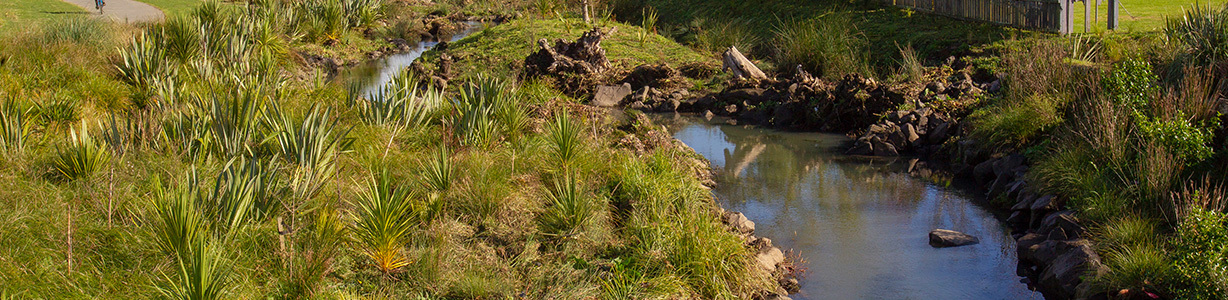
As part of the Making Space for Water programme, we identified 12 potential areas around the region that were either hit hard during the 2023 floods or that could most benefit from blue-green networks.
Blue-green networks
As part of the Making Space for Water programme, we identified 12 potential areas around the region that were either hit hard during the 2023 floods or that could most benefit from blue-green networks.
Blue-green networks
As part of the Making Space for Water programme, we identified 12 potential areas around the region that were either hit hard during the 2023 floods or that could most benefit from blue-green networks.
A blue-green network is a system of waterways (blue) and parks (green) that give stormwater space to flow and help reduce flooding where people live.
Find out more →